- Best overall: OM-1 Mark II (Amazon) / B&H Photo – full in-camera stacking, weather sealed, purpose-built for macro
- Best budget with stacking: Olympus E-M5 Mark II (Amazon) – full stacking capability at the lowest price available
- Best budget bracketing only: Olympus E-M10 Mark III (Amazon) – no stacking but solid bracketing
- Best full-frame: Nikon Z8 (Amazon) / B&H Photo – 45MP, excellent bracketing
- Best Sony: Sony A7R V (Amazon) / B&H Photo – 61MP, weather sealed
Please note that we do receive a commission from any sales linked from this website, but it is at the same cost to you with no hidden fees. We also always recommend buying used gear where possible — given that you can verify it is in great shape, secondhand photography equipment is one of the best ways to get professional-quality gear at a fraction of the price. The used macro lens buying guide covers what to look for before buying secondhand.
What is focus stacking and why does it matter?
Focus stacking is a technique where you take multiple photographs of the same subject, each focused at a slightly different point, and blend them into one final image where everything is sharp from front to back. It is the solution to one of the fundamental challenges of close-up photography: at macro distances, the depth of field is extremely shallow – often just a millimetre or two – which makes it nearly impossible to get an entire small subject in focus in a single frame.
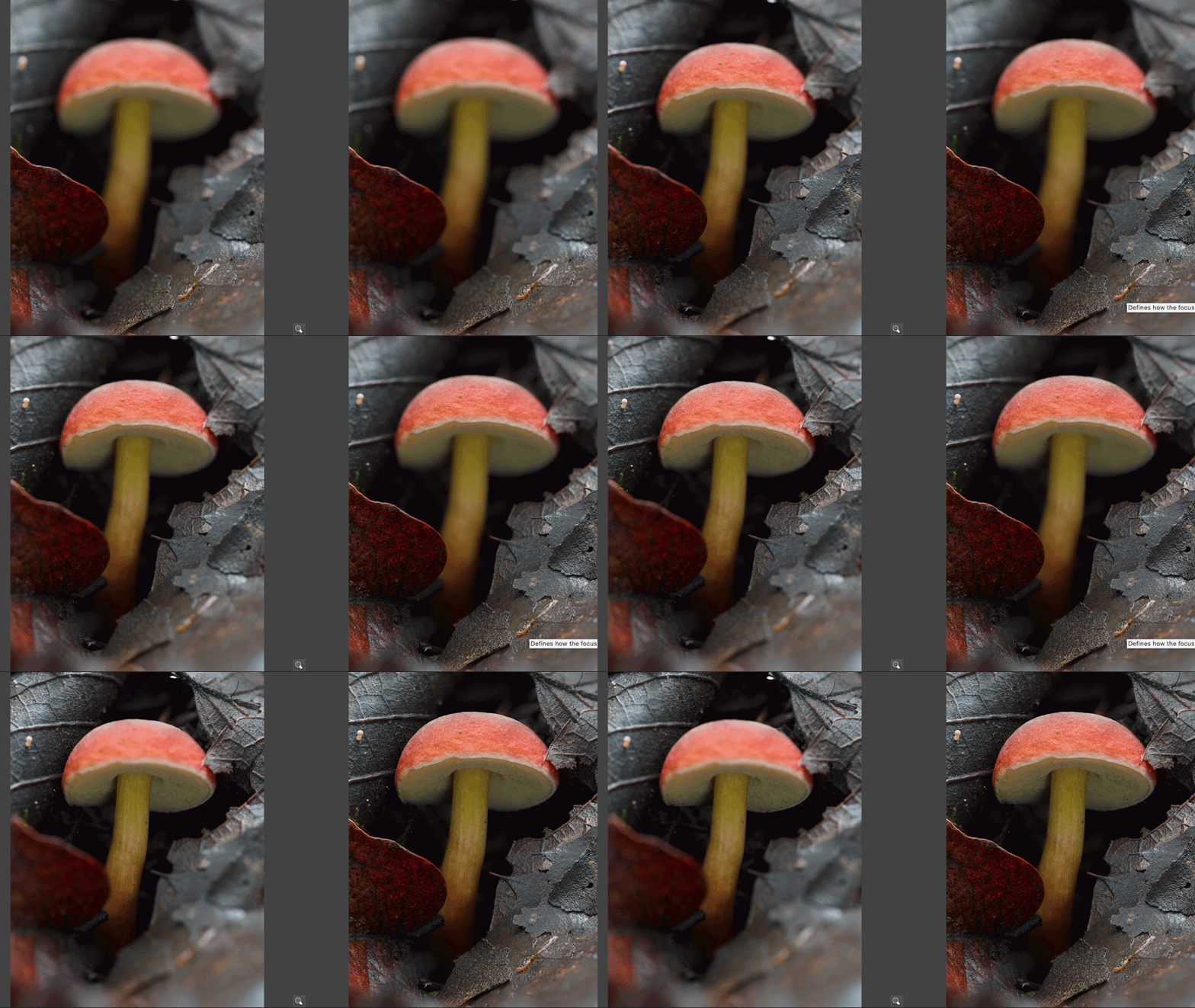
Focus stacking allows you to shoot at a wider aperture – which gives sharper individual frames and a more pleasing blurred background – while still achieving full depth of field across the subject through the stacking process. If you want to understand the technique in detail before deciding on a camera, the focus stacking explainer covers everything from scratch. For the reasoning behind aperture choice when stacking, there is also a dedicated article on why macro photographers shoot at wider apertures when focus stacking.
Focus bracketing vs focus stacking: what is the difference?
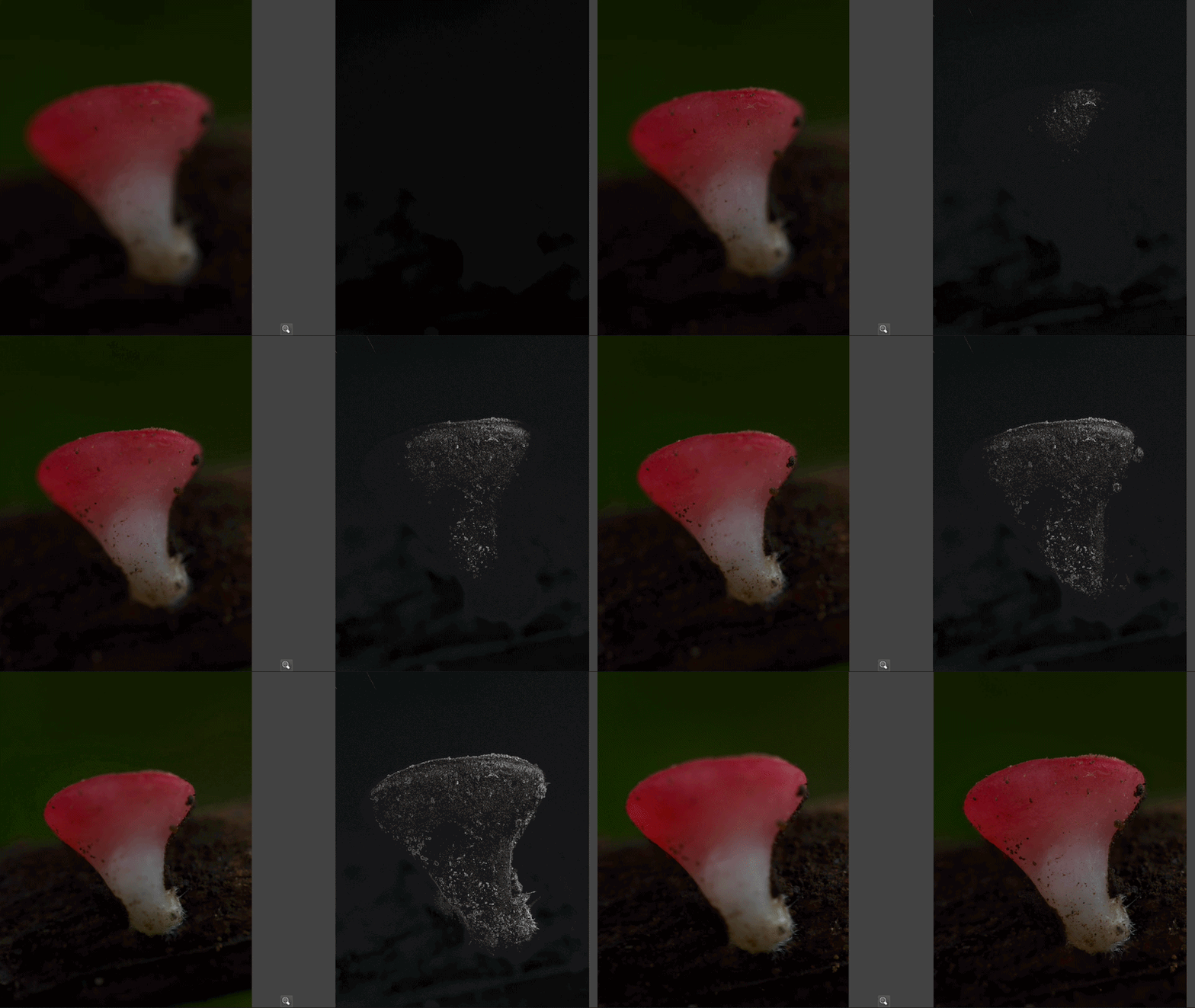
Focus bracketing is the shooting step: capturing a series of images each focused at a slightly different point. This can be done manually by turning the focus ring between shots or using a focusing rail, or automatically by the camera itself. Automatic in-camera bracketing fires the full sequence with a single button press.
Focus stacking is the post-processing step: merging those frames into one final image. This is typically done in software like Helicon Focus, Zerene Stacker, or Adobe Photoshop. Some cameras can also do a basic version of this in-camera.
Is this relevant if I don’t shoot fungi?
Absolutely. Focus stacking is used across a wide range of macro photography genres and the camera considerations are essentially identical regardless of subject. Insect photographers, flower and botanical photographers, product and jewellery photographers, and anyone shooting small subjects at high magnification will benefit from in-camera focus bracketing in exactly the same way.
Top picks
All the cameras in the full table support focus bracketing, but a few stand out for field macro work specifically. I am genuinely biased toward the Olympus/OM System lineup for macro work and will explain why, but the other picks here are solid recommendations for photographers already in those ecosystems.
OM System OM-1 Mark II
The current flagship of the OM System lineup and genuinely one of the best cameras available for macro and nature photography. Full in-camera focus stacking, IP53 weather sealing, 20MP sensor with excellent high-ISO performance, and 8.5 stops of in-body stabilisation. The stacked sensor fires bracketing sequences fast enough to minimise wind interference between frames. It pairs beautifully with the Olympus M.Zuiko 60mm f/2.8 Macro.
Olympus OM-D E-M1 Mark III
The predecessor to the OM-1 and still an excellent camera – available for significantly less, especially used. Same in-camera focus stacking capability, same weather sealing standard, works with the exact same lenses. For tripod-based macro work the differences from the OM-1 matter very little in practice.
Olympus OM-D E-M5 Mark II
The cheapest new camera with genuine in-camera focus stacking at around $415. Weather sealed, full stacking capability, full MFT lens compatibility. Older autofocus system and 16MP sensor, but for tripod-based macro work these trade-offs are very manageable.
Nikon Z8
45MP sensor, excellent bracketing, outstanding low-light performance. A versatile camera that excels at macro as well as wildlife, events, and general photography. Pairs beautifully with the Nikon Z MC 105mm f/2.8 Macro.
Sony A7R V
61MP full-frame sensor with extraordinary detail. Weather sealed, focus bracketing, pairs beautifully with Sony’s FE 90mm f/2.8 Macro G OSS. For gallery-quality macro imagery it absolutely delivers.
Fujifilm X-T4
Fujifilm’s APS-C cameras have a devoted following for their colour rendering and film simulations. The X-T4 supports focus bracketing, has in-body stabilisation, and a good selection of macro-compatible lenses.
Canon EOS R7
APS-C sensor, weather sealing, a very capable autofocus system, and focus bracketing. The best Canon option for macro work specifically. Pairs well with the Canon RF 100mm Macro.
Full camera comparison table
Every camera confirmed to support focus bracketing or in-camera stacking. Prices approximate as of mid-2026. Orange buttons = Amazon, blue buttons = B&H Photo (60-day cookie).
| Camera | Sensor | Bracketing | In-cam stacking | Weather sealed | Price | Buy |
|---|---|---|---|---|---|---|
| OM-1 Mark II ★ | MFT 20MP | ✓ | ✓ | ✓ | $2,000 | |
| OM System OM-3 | MFT 20MP | ✓ | ✓ | ✓ | $999 | |
| OM System OM-5 Mark II | MFT 20MP | ✓ | ✓ | ✓ | $1,199 | |
| OM-D E-M1 Mark III | MFT 20MP | ✓ | ✓ | ✓ | $738 | |
| OM-D E-M5 Mark II ◆ | MFT 16MP | ✓ | ✓ | ✓ | $415 | |
| OM-D E-M5 Mark III | MFT 20MP | ✓ | ✓ | ✓ | $647 | |
| OM-D E-M1X | MFT 20MP | ✓ | ✓ | ✓ | $2,702 | |
| OM-D E-M1 Mark II | MFT 20MP | ✓ | ✓ | ✓ | $578 | |
| OM-D E-M10 Mark IV | MFT 20MP | ✓ | — | — | $599 | |
| E-M10 Mark III | MFT 16MP | ✓ | — | — | $340 | |
| Panasonic G9 II | MFT 25MP | ✓ | ✓ | ✓ | $1,797 | |
| Panasonic G80/G85 | MFT 16MP | ✓ | — | ✓ | — | |
| Nikon Z8 ⬡ | Full frame 45MP | ✓ | — | ✓ | $3,796 | |
| Nikon Z9 | Full frame 45MP | ✓ | — | ✓ | $5,296 | |
| Nikon Z7 II | Full frame 45MP | ✓ | — | ✓ | $2,196 | |
| Nikon Z6 III | Full frame 24MP | ✓ | — | ✓ | $1,997 | |
| Nikon Z6 II | Full frame 24MP | ✓ | — | ✓ | $1,646 | |
| Nikon Z5 II | Full frame 24MP | ✓ | — | — | $1,696 | |
| Nikon D850 | Full frame 45MP | ✓ | — | ✓ | $1,273 | |
| Nikon D780 | Full frame 24MP | ✓ | — | ✓ | $1,746 | |
| Sony A7R V ⬡ | Full frame 61MP | ✓ | — | ✓ | $3,298 | |
| Canon EOS R5 | Full frame 45MP | ✓ | — | ✓ | $2,799 | |
| Canon EOS R3 | Full frame 24MP | ✓ | — | ✓ | $4,399 | |
| Canon EOS R6 Mark II | Full frame 40MP | ✓ | — | ✓ | $2,299 | |
| Canon EOS R6 Mark III | Full frame 20MP | ✓ | — | ✓ | $2,799 | |
| Canon EOS R7 | APS-C 32MP | ✓ | — | ✓ | $1,549 | |
| Canon EOS R10 | APS-C 24MP | ✓ | — | — | $999 | |
| Canon EOS RP | Full frame 26MP | ✓ | — | — | $1,049 | |
| Canon EOS 90D | APS-C 32MP | ✓ | — | — | $1,571 | |
| Fujifilm GFX 100 | Medium format 102MP | ✓ | — | ✓ | $4,410 | |
| Fujifilm GFX 50S | Medium format 51MP | ✓ | — | ✓ | $2,000 | |
| Fujifilm X-H1 | APS-C 24MP | ✓ | — | ✓ | $799 | |
| Fujifilm X-T4 | APS-C 26MP | ✓ | — | — | $1,349 | |
| Fujifilm X-T3 | APS-C 26MP | ✓ | — | — | $884 | |
| Fujifilm X-T2 | APS-C 24MP | ✓ | — | — | $670 |
★ Best overall ◆ Best budget ⬡ Best premium Highlighted rows are recommended picks AMZ = Amazon B&H = B&H Photo (60-day cookie) Prices approximate as of mid-2026
Accessories to consider
- Macro lens – A dedicated macro lens is essential for photographing small subjects. A good macro lens sometimes costs as much as or more than the camera body.
- Tripod – Essential for focus stacking. Any camera movement between frames creates misalignment that software struggles to correct.
- Focusing rail – Useful for precise manual focus shifts when shooting manually or as a supplement to automated bracketing.
- Extension tubes and Raynox DCR-250 – For pushing magnification beyond what a standard macro lens provides.
- Lighting – A small portable LED panel and a simple reflector make a significant difference for illuminating the underside of caps and gills.
- Remote shutter release – Eliminates vibration from pressing the shutter button directly.
FAQ
Do I need a camera with in-camera stacking, or can I just use software?
You do not need it. Most serious photographers use in-camera bracketing to capture the sequence rapidly in the field, then merge in Helicon Focus or Zerene Stacker on the computer for full RAW quality and complete control.
Why does B&H Photo appear alongside Amazon for some cameras?
B&H Photo is one of the most trusted photography retailers in the world and often has competitive pricing. Use whichever retailer you prefer.
How many shots do I need for a focus stack?
A medium-sized mushroom at moderate magnification might need 10 to 20 frames. A tiny Mycena at high magnification could need 50 to 100. A slime mold sporangium at extreme magnification can need 200 or more.
Is Micro Four Thirds better than full-frame for macro photography?
For macro specifically, MFT has real practical advantages. The 2x crop factor effectively doubles depth of field at a given aperture compared to full-frame, meaning fewer frames needed per stack. The system is also more compact and lighter for field work.
Does this apply to insect, flower, or product photography too?
Yes, entirely. The camera features that matter – in-camera bracketing, macro lens compatibility, weather sealing for field work – are relevant whether you are shooting fungi, insects, flowers, jewellery, or any other small subject at high magnification.
What software is best for stacking?
Helicon Focus and Zerene Stacker are the most popular among professional macro photographers. There is a full guide on how to use Helicon Focus if you want to get started.
What is the cheapest camera that supports focus stacking?
The Olympus E-M10 Mark III at around $340 supports focus bracketing. The OM-D E-M5 Mark II at around $415 supports full in-camera stacking. See the complete cameras guide for all options.
This list is updated as new cameras are released. If you know of a model that should be included, send me a message.
Best of luck out there.