What is a chanterelle?
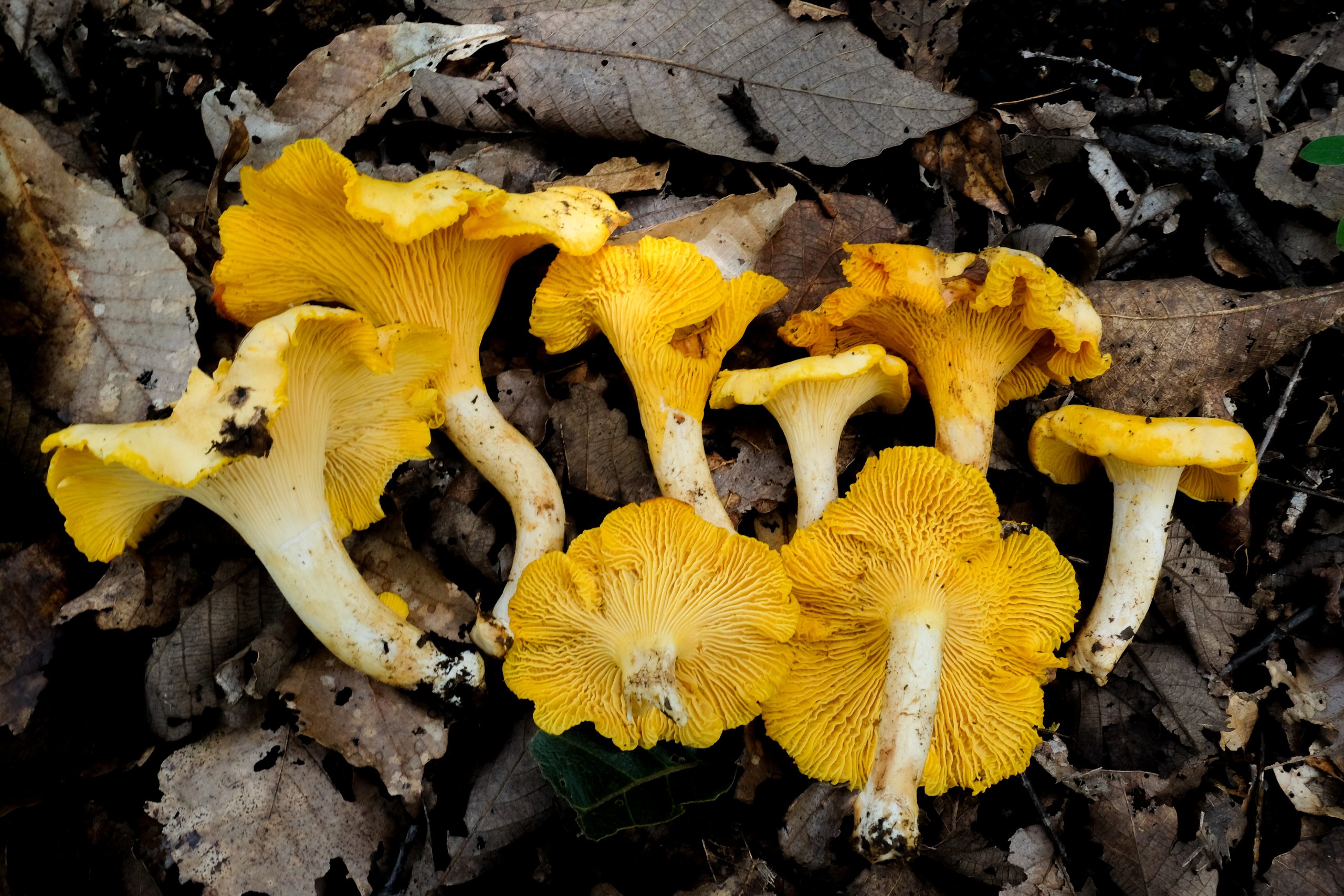
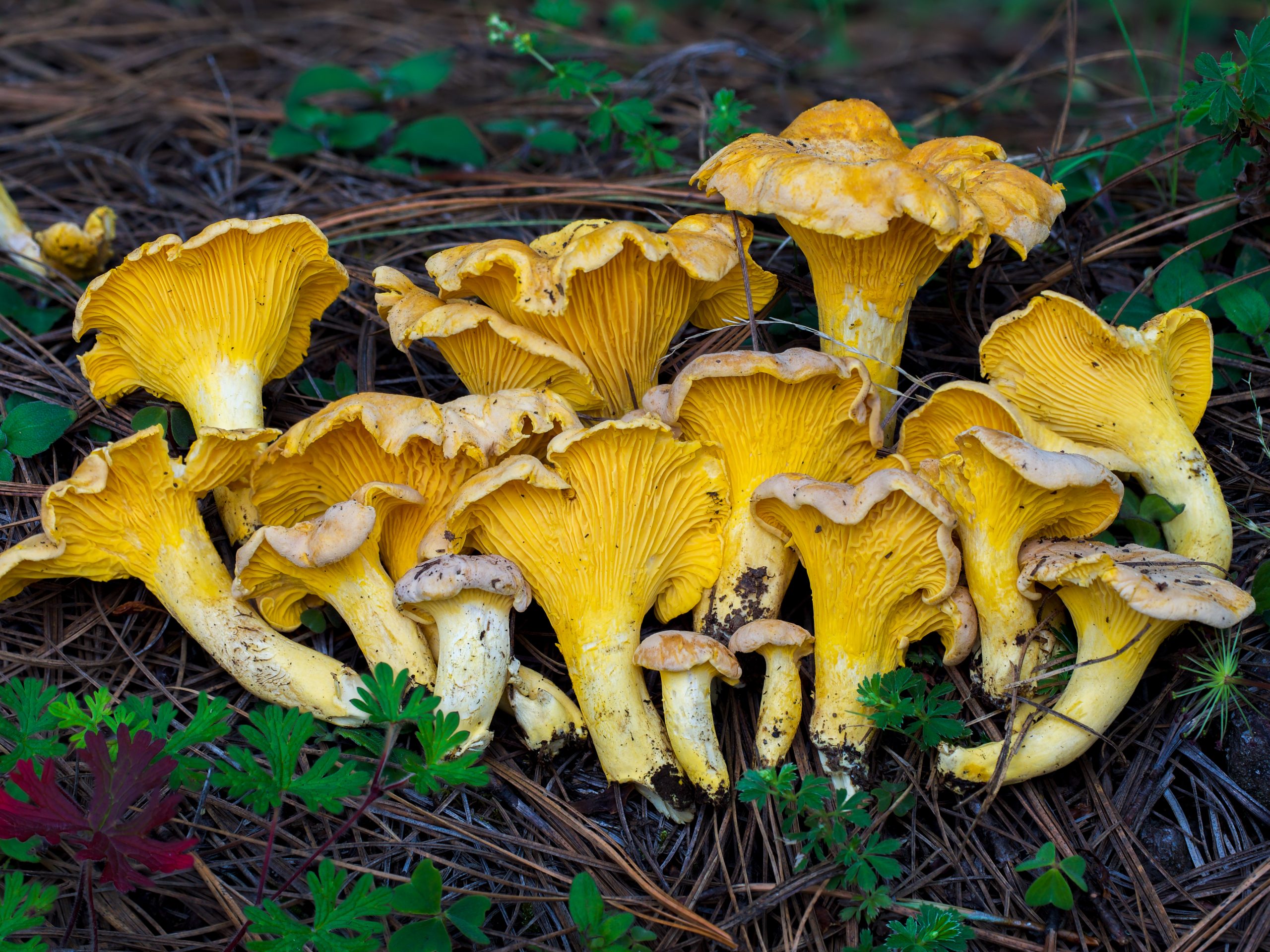
The common name chanterelle typically refers to a handful of species in the genus Cantharellus, as well as Craterellus. These are among the most prized edible wild mushrooms in the world, instantly recognisable by their golden-yellow colour, wavy cap margins, and distinctive forking ridges rather than true gills on the underside. They are found across temperate forests worldwide and have been collected and eaten for centuries.
The scientific name: Cantharellus and its ancient roots
Chanterelles were first formally described by the Swedish mycologist Elias Magnus Fries in the 19th century, with the type specimen named Cantharellus cibarius. The genus name Cantharellus was likely inspired by the pre-existing common name chanterelle, which was already in use in France. It is possible that Fries also had in mind the Latin word cantharus, meaning drinking vessel or cup, as a nod to the mushroom’s chalice-like shape, but the true reason behind his choice is not definitively documented. What is clear is that the name chanterelle itself has its own separate origins, distinct from the ancient vessel word, which we cover in the next section.
What makes the cantharus connection etymologically interesting regardless of Fries’s intent is how far back that word lineage actually goes. Cantharus traces through ancient Greek (κάνθαρος) and Akkadian (𒃶𒁺𒊒𒌑), all the way back to the Sumerian word gannu-tur (𒄑𒃶𒉡𒌉), which means little vessel. That makes it one of the oldest recoverable word lineages connected to any mushroom name.
The Sumerian word gannu-tur — “little vessel” — written in cuneiform.
The common name: chanterelle
The common name chanterelle originated in France and was later adopted into English. Despite this French origin, it is worth noting that in most parts of France today, these mushrooms are actually called girolle, not chanterelle. The name chanterelle is more of an internationally adopted French export than the name most French people actually use.
The oldest recorded use of the name as applied to this mushroom appears to come from a 1698 book, Histoire des plantes qui naissent aux environs de Paris by M. Pitton de Tournefort, who gives a brief description of the mushroom under this name. It was used again by French mycologist Michael Adanson in his 1763 book Familles des Plantes, written as “Chanterel”.

Interestingly, despite being in use for at least three centuries in France, there is evidence that it was not a widely known name until the 20th century. The Dictionary of the French Academy did not include the mushroom definition of chanterelle until 1935, despite including other meanings for the word much earlier.
The singing mushroom and other meanings
The word chanterelle carried several other meanings in French long before it was attached to this mushroom, which adds a layer of ambiguity to the etymology. Historically the word referred to:
- The highest-pitched string on a violin or other string instrument
- A thin glass bottle that produces musical sounds when blown across
- A decoy bird placed in a cage to attract other birds into nets by its song
- A type of pick used to play string instruments
- The melody pipe of a bagpipe, known in English as a chanter
7th Edition of the Dictionary of the French Academy, 1879
Robert Kaye Greville, in his 1823 Scottish Cryptogamic Flora, suggested that the mushroom name came from a fancied resemblance to “the open beak, or the head of a cock in the act of crowing.” Whether the name was originally chosen for its musical associations, its resemblance to an instrument, or its vocal qualities, the exact reason remains unclear. What is clear is that the word chanterelle carried connotations of song and sound long before it became firmly associated with this mushroom.
Over 50 French folk names
While chanterelle and girolle are the best-known French names, the 20th-century mycologist Henri Romagnesi documented over 50 regional folk names for chanterelles across France. This remarkable variety reflects just how widely gathered and culturally embedded this mushroom has been in French rural life for centuries.
Chanterelle, chanterelle comestible, chanterelle commune, aoureilleto, areglietta, bouche-de-lièvre, boulingoulo, brigoule, cassine, cheveline, chevrelle, chevrille, chevrette, chevrotte, chevrotine, corne d’abondance, craterelle, crête-de-coq, cresta del Gal, crobilio, crobillo, escargoule, escraville, escrobillo, essau, gallet, gallinace, gerille, ginestrolle, gingoule, ginistrolle, giraudet, giraudelle, girolle, gyrolle, girole, girondelle, grillo, jaunelet, jaunette, jaunire, jauterelle, jaunotte, jeannelet, jerilia, jirboulette, jorille, lacesseno, lechocendres, lechocendré, mérule, moelle-de-terre, mousseline, oreille de lièvre, roubellou, roussette, roussotte, roussonne, tournebous, tornebous, tourne-bœuf.
Some of the more interesting ones interpreted:
- Girolle The most widely used name in France today. Likely derived from a cheese-cutting device called a girolle or “cheese curler,” which cuts fine curling slices from semi-hard cheese that roll up and resemble the shape of a chanterelle.
- Cheveline / Chevrette / Chevrotine Names likely referring to young goats or deer, possibly from the mushroom’s shape or colour.
- Crête-de-coq Means rooster crest. The same image appears in Italian folk names (gallinaccio, related to chicken) and many other languages.
- Jaunelet / Jaunette / Jaunire / Jaunotte All derived from jaune, the French word for yellow, referring simply to the mushroom’s colour.
- Lèche-cendres Translates literally as “ash licker,” possibly related to a tool name or the mushroom’s association with certain soil types.
- Roubellou Origin unclear, but it resembles the Catalan name rovellon used for Lactarius deliciosus.
- Escraville According to Greville, this is a corruption of esca villae, meaning “food of the village.”
Global names from around the world
In 1823, Robert Kaye Greville’s Scottish Cryptogamic Flora documented traditional names for chanterelles across Europe, noting that in Devon, England, the mushroom was historically called the “Pickseystool” in reference to pixies or local fairies. He also recorded a Dutch name, hemelsch Manna, meaning “manna from heaven,” reflecting the mushroom’s status as a highly prized food.
Below is a full table of common names across languages, drawn from published mycological and linguistic sources.
| Language | Common names and meanings |
|---|---|
| Basque | Baina, Lekazina, Saltzaperretxiko (sauce mushroom), Txaltxatua |
| Catalan | Agerola (from Girolle), Bolet cabriter, Camagroc, Ginestola, Ginesterola, Girola, Ull de perdiu (partridge eye), Vaqueta |
| Chinese | Huangzhi-gu (yellow cape jasmine mushroom), Jidanhuang (egg yolk), Jiyou-jun (chicken fat mushroom), Xingjun (apricot mushroom) |
| Czech | Kuratko (chick), Liska (fox) |
| Dutch | Hanekam (cock’s crest) |
| Estonian | Harilik kukeseen (common cock mushroom) |
| Finnish | Kantarelli (from chanterelle), Keltasieni (yellow mushroom) |
| French | Chevrette (small goat), Crête de coq (cock’s crest), Gallinace (chicken), Jaunette (little yellow), Oreille de lièvre (hare’s ear), Rossinyol (nightingale) |
| German | Eierschwamm (egg mushroom), Pfifferling (pepper mushroom), Dotterpilz (egg yolk mushroom), Gelbhähnel (yellow chick), Hasenöhrlein (little hare ear), Rehfüsshen (deer’s foot), Ziegenbart (goat’s beard) |
| Hungarian | Csirke gomba (chicken mushroom), Roka gomba (fox mushroom) |
| Icelandic | Kantarella (from chanterelle) |
| Italian | Galletto (young rooster), Galuschel (yellow ear), Orecina (little ear) |
| Japanese | Anzutake (apricot mushroom) |
| Korean | Kkue-kko-ri beosus (nightingale mushroom), Sal-gu beosus (apricot mushroom) |
| Mexican Spanish | Amarillo (yellow), Corneta (trumpet), Duraznillo (small peach), Seta amarilla (yellow mushroom), Seta de San Juan (St. John’s mushroom) |
| Nahuatl | Xochilnanácatl (flower mushroom) |
| Norwegian | Kantarell (from chanterelle) |
| Polish | Kurka (chicken) |
| Portuguese | Canarinhos (canary bird), Cantarelos (from chanterelle), Mãozinhas (baby hands) |
| Romanian | Galbiori (yellowish one) |
| Russian | Lisitjka (fox mushroom) |
| Spanish | Cabrilla (chicken), Carn de gallina (chicken meat), Gallinaccio (chicken), Seta amarilla (yellow mushroom) |
| Swahili | Wisogolo |
| Swedish | Gullsvamp (golden mushroom), Vingesvamp (wing mushroom) |
| Thai | Hed Kamin Yai (large Kamin mushroom) |
| Turkish | Yumurta mantari (egg mushroom) |
| Ancient Hungarian | Niwl gomba (hare mushroom) |
What stands out across these names is how consistently certain themes recur: yellow colour (German Pfifferling, Romanian galbiori, Chinese jidanhuang), chickens and roosters (Italian galletto, Polish kurka, Hungarian csirke gomba), foxes (Russian lisitjka, Czech liska), eggs (German eierschwamm, Turkish yumurta mantari), and apricots (Japanese anzutake, Korean sal-gu beosus). People across vastly different cultures and languages reached independently for the same handful of comparisons.
Etymology of specific Cantharellus species names
The genus Cantharellus contains many species, each with a Latin or Latinised epithet that tells its own story:
- C. cascadensis Refers to the Cascade Mountains of the Pacific Northwest, indicating its geographic range.
- C. cibarius From the Latin cibus meaning food, indicating that this species is edible. The most commonly eaten and most widely recognised chanterelle.
- C. cinnabarinus From cinnabaris, meaning cinnabar, a red mineral. Refers to the mushroom’s distinctive red-orange colour.
- C. formosus From the Latin formosus, meaning beautiful or handsome. Found primarily along the Pacific Coast of North America.
- C. lateritius From later, meaning brick, in reference to its brick-orange colour.
- C. minor From the Latin minor, meaning smaller, distinguishing it from related species.
- C. roseocanus A combination of roseus (rosy) and canus (grayish), describing its mixed colouration.
- C. subalbidus From sub (somewhat) and albidus (whitish), meaning slightly white. A pale Pacific chanterelle species.
Sources: Pilz, D., Norvell, L., Danell, E., & Molina, R. (2003). Ecology and management of commercially harvested chanterelle mushrooms. U.S. Department of Agriculture, Forest Service, Pacific Northwest Research Station. Greville, R.K. (1823). Scottish Cryptogamic Flora. Adanson, M. (1763). Familles des Plantes.