A beginner-friendly explanation of Micro Four Thirds cameras — what they are, why some photographers love them, why others criticize them, and why they might just be the best tool for macro and fungi photography specifically.
First things first: what even is a sensor?
Before we get into Micro Four Thirds specifically, it helps to understand what a camera sensor is. Think of it like the digital version of film. It’s the chip inside your camera that actually captures the light coming through your lens and turns it into a photo. The bigger the sensor, generally speaking, the more light it can capture — and the more detail it can record.
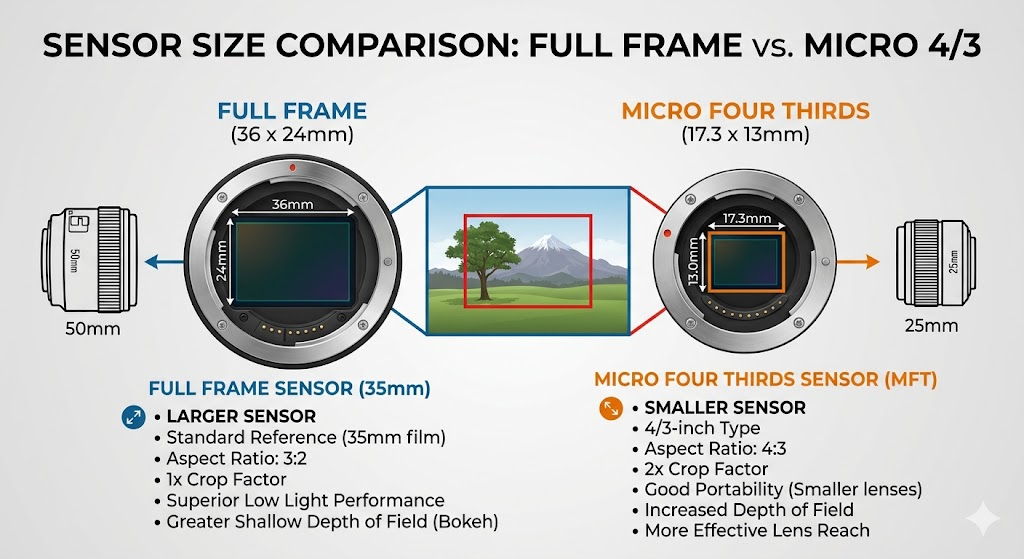
Camera sensors come in a few standard sizes. The biggest ones you’ll hear about are called full-frame, which are roughly the size of a frame of old 35mm film. Below that you have APS-C sensors, which are a bit smaller. And then there’s Micro Four Thirds — smaller still, but not tiny. Think of it like this: if a full-frame sensor is a dinner plate, an APS-C is a salad plate, and Micro Four Thirds is a side plate. All perfectly usable, just different sizes with different trade-offs.
So what is Micro Four Thirds exactly?
Micro Four Thirds — often written as MFT or M4/3 — is a camera system developed jointly by Olympus and Panasonic back in 2008. It’s both a sensor size and a lens mount standard, which means lenses from Olympus and Panasonic are fully compatible with each other’s cameras. That’s actually a big deal, because it means you have a wide range of lenses to choose from regardless of which brand body you buy.
The “Four Thirds” name comes from an old TV industry measurement — the sensor has a 4:3 aspect ratio, meaning photos are slightly more square than the wider 3:2 ratio you get from full-frame cameras. The “Micro” part just means the lens mount was made smaller and more compact compared to the original Four Thirds system that came before it.
The cameras you’ll see most often in the MFT world are the Olympus (now OM System) OM-D series and the Panasonic Lumix G series. If you’ve read my article on cameras for focus stacking, you’ll know I’m a big fan of the Olympus lineup for fungi photography in particular.
| Micro Four Thirds | APS-C | Full frame | |
|---|---|---|---|
| Sensor size | 17.3 × 13 mm | 23.5 × 15.6 mm | 36 × 24 mm |
| Crop factor | 2× | 1.5–1.6× | 1× (none) |
| Low light performance | Good | Very good | Excellent |
| Macro advantage | Excellent | Good | Moderate |
| Background blur (bokeh) | Moderate | Good | Excellent |
| Size & weight | Compact | Medium | Bulky |
| In-cam focus stacking | Yes (Olympus) | No | No |
| Best for | Macro, nature, travel | All-round photography | Portrait, low light, studio |
What are the advantages of Micro Four Thirds?
1. Smaller and lighter gear
Because the sensor is smaller, the whole system can be more compact. The camera bodies are smaller, and the lenses tend to be physically smaller, too. For nature and fungi photography, where you’re hiking through forests, getting low to the ground, and carrying gear for hours, this genuinely matters. A full-frame camera with a macro lens can get heavy fast. An MFT setup gives you a lot of capability without as much weight.
2. The crop factor works in your favour for macro
This is the big one for fungi photography. MFT sensors have what’s called a 2x crop factor. Here’s what that means in plain terms: because the sensor is smaller, it captures a narrower field of view than a full-frame camera using the same lens. So a 60mm lens on an MFT camera effectively behaves like a 120mm lens on a full-frame. You get more reach, more magnification, and more of your subject in the frame — without having to physically get any closer.
But there’s another side to this that’s even more useful for macro specifically: depth of field. At macro distances, depth of field — meaning how much of your subject is in sharp focus — is extremely shallow. Frustratingly shallow, actually. The crop factor means that to get the same field of view as a full-frame camera, you can use a wider aperture, which gives you more light and slightly more depth of field to work with. In practice, this means fewer frames needed per focus stack, and a bit more flexibility when shooting.
3. Great lens ecosystem for macro
The MFT system has some genuinely excellent macro lenses. The Olympus 60mm f/2.8 Macro is widely considered one of the best macro lenses available for any system, and it’s a fraction of the price of comparable full-frame options. Because both Olympus and Panasonic use the same mount, you have a solid range of options to choose from.
4. In-camera focus stacking on Olympus bodies
This one is specific to Olympus / OM System cameras, but it’s worth mentioning here. Many of their MFT bodies offer full in-camera focus bracketing and stacking — meaning the camera automatically takes the sequence of shots and blends them into one image, all without needing a computer. No other system does this as well or as consistently. It’s one of the main reasons the Olympus lineup is so popular among macro photographers.
What are the disadvantages?
1. More noise in low light
This is the main trade-off with a smaller sensor. In low-light conditions, such as a dark forest floor or shooting on an overcast day, MFT cameras tend to produce more digital noise (that grainy, speckled look in photos) than full-frame cameras at the same settings. Modern MFT cameras have gotten much better at this, but it’s still a real difference. If you’re doing a lot of low-light photography, a full-frame camera has an edge here. The good news is that mushrooms don’t move, so a tripod comes in handy for these situations. Also, if you do focus stacking, you can have your aperture wide open so more light can reach the sensor.
2. Less “background blur” than full-frame
A lot of photographers love the look of a subject in sharp focus against a beautifully blurred background — what’s often called “bokeh.” Full-frame cameras are generally better at producing this effect. With MFT, you can still get nice background blur, especially at close macro distances, but it won’t be as dramatic as what you’d get with a full-frame and a fast lens. For fungi photography, specifically, this matters less, since you’re usually focused on getting everything sharp rather than blurring anything out.
3. The critics — is it a “serious” system?
There’s a vocal corner of the photography world that looks down on anything smaller than full-frame. The argument goes that if you’re serious about photography, you should be using a full-frame camera — and that MFT is somehow a compromise or a beginner’s choice. I’d push back on this pretty firmly. The gear debates online can get exhausting, and they often miss the point entirely. Some of the most breathtaking macro photos of fungi and other small organisms in existence were shot on Micro Four Thirds cameras. The system is absolutely capable of professional results in the right hands and the right situation.
That said, the critics aren’t completely wrong that full-frame has advantages — particularly in low light and in producing that compressed, shallow depth of field look that’s popular in portrait and wildlife photography. But for macro nature photography specifically, those advantages matter less than they do in other genres.
So is Micro Four Thirds right for you?
If mushroom and macro photography is your thing, honestly — yes, probably. The combination of a compact system, a great macro lens ecosystem, and the unique focus stacking capabilities of the Olympus lineup make MFT a genuinely excellent choice for this specific type of photography. It’s not the right tool for every job, but for crawling around a forest floor photographing tiny fungi, it’s hard to beat.
If you’re curious about which specific MFT cameras I’d recommend, I’ve put together a full comparison table with all the cameras that support focus bracketing and stacking — check it out here.
Best of luck out there!
No responses yet